
Blog
Her working hours, her rate, and what you agree yourself
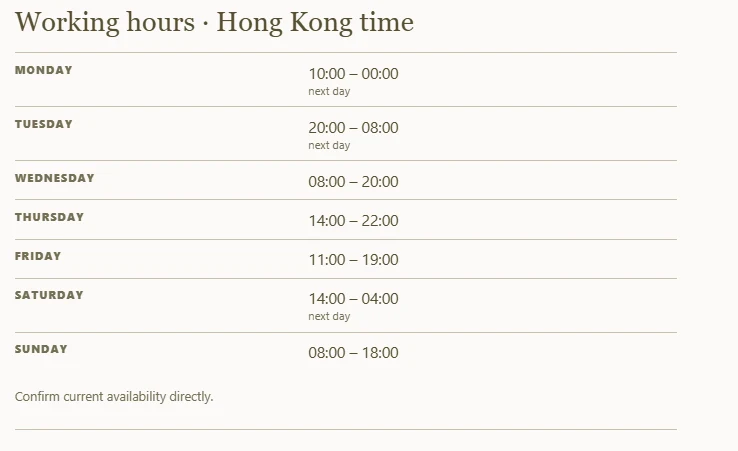
Two things on a profile decide when the evening can happen and what it costs: her working hours and her rate. Both are hers. She sets them, she publishes them, and the page prints what she wrote and nothing more. Read as fixed terms they will cost you a wasted message; read as her own account of how she normally works, they tell you most of what you need before writing to her.
Where her working hours are, and how to read them
Every profile carries a block headed Working hours · Hong Kong time. The timezone is spelled out, which matters the moment you are writing from a different one.
Underneath it, three things are worth knowing before you plan around them.
- A day is either a pair of times or the word Closed. Closed means a day she does not work, not a day nobody filled in. It is her decision, published.
- Hours that end after midnight are marked next day. A woman who starts in the evening and finishes in the small hours has a working day that runs through the night, so late at night falls inside her hours, not past them.
- Some profiles say Available 24/7 instead of showing a week. That means she has not set aside particular days. It does not mean she is awake now.
The same hours feed the Available now filter on the listing pages: it gathers the women whose published hours cover the moment you are looking, in Hong Kong time. Being on that list means she is inside her working hours — no more than that.
Which is why a line sits under every schedule: Confirm current availability directly. A day marked open can already be full, and the calendar has no way of knowing.
Can you book outside her working hours?
That is hers to answer, and only hers. Nothing stops you asking and nothing obliges her to say yes. The hours describe when she normally works; they are not a shutter that comes down.
Reasons a woman agrees to a time outside them are ordinary enough — a quiet week, a day marked Closed for something that fell through, an early start she does not mind for a booking worth starting early. Reasons to decline are just as everyday, and they are not explained to you.
The way to ask makes a difference. A question about the specific day and time you want can be answered yes or no in one line. A question about whether she is flexible in general asks her to write a policy, and she will not.
Is there any point writing outside her hours?
Yes, as long as you adjust what you expect back rather than what you send.
Some women answer whenever the phone lights up. Others read messages when the working day starts, which is exactly what the published week is telling you. A message sitting unanswered in the middle of the night has usually not been refused; it is in a queue that opens later.
So the schedule is worth reading twice: once for when she works, and once for when your message is likely to be read. Writing the night before a day she has marked open is often better timed than writing in the middle of a day she has marked Closed.
The rate is priced against the hour
Her Rates block lists a rate against one hour, and that is the unit the whole arrangement is priced in. One length, one figure, per woman — which is why comparing two profiles is comparing two hours, and nothing else needs converting.
The caption on that table calls the figures estimated, and the word is doing real work. It is her stated price for an ordinary booking, not a locked quote, and it does not carry travel, longer arrangements or anything the two of you agree after it.
Longer and shorter than an hour
There is no longer option to pick, because a longer booking is something she agrees to, not a product on a shelf. That they happen is visible in the writing already on the page — reviews that record how long each booking ran are not all an hour long. Ask for the length you want and let her price it, rather than multiplying the hourly figure yourself and treating the answer as agreed.
A shorter booking works the other way round. Where a woman offers one, it tends to carry a floor of its own instead of a slice of the hourly rate, and what fits inside it is hers to define. Ask before assuming a short slot is the same evening at a discount.
One rule worth carrying, because directories that publish their terms tend to state it plainly: arrive late and the late time comes out of the booking, with the full fee still due. The hour starts when it was agreed to start.
Read both blocks before you write and the message almost composes itself: you already know which day is open, roughly when she will see it, and what a standard hour costs. What is left is the part no page can answer — a longer evening, a time outside the published week, a night that runs past her usual finish. Among independent escorts setting their own hours in Hong Kong that answer changes woman to woman, so it gets asked and not looked up.